
Photography Safari From Kgalagadi to the Okavango Delta Wildlife Experience
Into the Wild: From Red Dunes to Blue Delta
Few journeys capture Africa’s raw essence like the route from the Kgalagadi Transfrontier Park to the Okavango Delta. One begins amid scarlet dunes and stark silence, where lions roar through the chill of a Kalahari dawn. The other ends in a labyrinth of waterways alive with elephants, fish eagles, and the rhythm of life that pulses through the Delta’s emerald channels. Together, they tell the story of Africa’s contrasting souls, desert and delta, dust and water, solitude and abundance.
For a wildlife photographer, this route is more than a scenic drive; it’s a masterclass in light, patience, and perspective. The Kgalagadi’s open landscapes train your eye for minimalist compositions and long-lens storytelling, while the Delta’s mirrored lagoons challenge you to master reflection, texture, and movement. Every kilometer between these two ecosystems offers a new photographic lesson and a deeper connection to Africa’s untamed character.
At Mtembezi African Safaris, we’ve guided countless photographers and nature enthusiasts on this journey. This true Okavango Delta wildlife photography safari begins in the red dunes and ends among the blue lagoons. We know that a memorable image is born not only from timing and gear but also from understanding the land: how the herds migrate, when the light turns gold, and where silence reveals more than sound.
Whether you’re carrying a camera for the first time or refining your professional portfolio, our expert guides ensure your experience balances artistry, adventure, and ethical travel. This isn’t just a safari; it’s a story you’ll photograph frame by frame.
In this guide, we’ll share how to travel this remarkable route like a seasoned explorer:
- How to prepare your photography kit for desert dust and delta mist
- Where to find the most rewarding vantage points
- When to travel for the best light and wildlife encounters
- How to move through these landscapes responsibly, leaving only footprints and photographs behind
So pack your lenses, charge your batteries, and open your eyes to Africa’s wild heart, a world where red dunes fade into blue delta waters, and every sunrise promises another story worth capturing.
The Call of the Kgalagadi: Where the Journey Begins
The Kgalagadi Transfrontier Park is where Africa’s heartbeat slows to a steady rhythm. Here, the landscape burns red beneath vast skies, and mornings bite with cold so sharp that ice glistens on tent flaps. It is a place of silence and patience, where every track in the sand tells a story and every shadow might be a lion.
For wildlife photographers, Kgalagadi offers the perfect blend of challenge and reward. The open terrain makes it ideal for learning to work with light and distance. The best photography hours are early morning and late afternoon, when the sun softens, and the dunes glow with copper tones. A telephoto lens, ideally 400mm or longer, is essential to capture the shyer residents like gemsbok and cheetahs without disturbing them. A bean bag or window mount will help stabilize shots from your vehicle, while a second camera body with a wider lens captures dramatic skies and dust trails.
Life here is built around survival. Lions patrol the dry riverbeds, often silhouetted against glowing sand ridges. Meerkats stand guard at sunrise, their eyes scanning for danger while the light paints their fur in gold. Gemsbok wander quietly across the horizon, horns cutting against the amber light. Each moment is fleeting, yet every image feels timeless.
Water in the Kgalagadi Transfrontier Park – How does it work? Kgalagadi Photography
Kgalagadi rewards those who prepare. The park’s distances are long, roads are rough, and fuel stops are scarce. Always top up your tank before entering, carry extra water, and keep your camera batteries warm in the cold mornings. Permits are required for cross-border routes, and booking your campsites in advance is essential. This is true wilderness, remote, vast, and unforgettable. Those who embrace its solitude find not only great photographs but also a deeper understanding of Africa’s wild spirit.
Crossing into Botswana: The Long Road North
Leaving the Kgalagadi feels like stepping from one world into another. As the red dunes fade in your rearview mirror, the road begins to stretch toward the heart of Botswana. The journey north is long but rewarding, passing through quiet villages, endless horizons, and landscapes that slowly transform from arid savanna to green floodplains.
This drive teaches photographers a different kind of patience. The changing scenery offers opportunities to capture road-trip moments: lone baobabs, dusty convoys, and the glow of sunset through the windshield. Keep your camera ready; some of the best images happen between destinations.
Okavango’s Wilderness, Khwai’s Golden Light: Our Botswana Safari Adventure’s Last Chapter
For travelers driving from Kgalagadi to the Okavango Delta, planning is key. Border crossings such as McCarthy’s Rest or Bokspits are straightforward but require valid passports and vehicle papers. Roads are mostly gravel and can be slow going, but they pass through some of Botswana’s most photogenic countryside. Carry enough fuel, snacks, and water for the journey, as refueling stops can be several hundred kilometers apart.
This route is not just a transfer; it is part of the adventure. Slow travel allows you to notice the subtle changes, the sand giving way to scrub, the scrub turning to trees, and finally, the first hints of water as you near Maun. Every kilometer north is a promise of what’s to come.
From the Sky to the Swamps: Experiencing the Delta in Three Dimensions
The Okavango Delta is one of the world’s great natural wonders, and the best way to grasp its scale is from above. A helicopter or small-plane flight reveals a breathtaking mosaic of winding channels, islands, and floodplains glowing in shades of green and gold. For photographers, this is the moment to create abstract aerial images, elephant herds forming delicate patterns across grasslands, or hippos etching trails through the shallow waters. Early morning flights provide the softest light and minimal haze.
Once you touch down, the Delta reveals its quiet rhythm at ground level. Glide silently through narrow channels in a mokoro canoe, camera balanced on your lap as kingfishers dart overhead. Elephants wade through the reeds, their reflections rippling across still water. Early mornings and late afternoons gift you with the kind of golden light that turns every scene into art.
THIS Is the African Safari to Go On | Botswana’s Okavango Delta
A versatile zoom lens (70–200mm) works beautifully here, as you’re often close to your subjects. Use a polarizing filter to manage reflections and always keep your equipment dry. More important than any technical setting is respect, photographing from a safe distance, and allowing animals to move freely. True wildlife photography is built on patience, not pursuit.
The Delta rewards stillness. Every image feels alive with sound: the rustle of papyrus, the splash of a hippo, the distant call of a fish eagle. It’s here, in this watery wilderness, that photography becomes meditation.
Into the Wild: Lions, Elephants & the Pulse of the Delta
Every photographer dreams of moments that steal the breath away, and the Okavango Delta delivers them daily. Dawn breaks slowly over the reeds, mist rising from still water as the wilderness stirs awake. Somewhere nearby, lions roar, deep, echoing calls that vibrate through the air. Within minutes, you find fresh tracks in the sand. This is when patience meets instinct, and true photography begins.
For anyone on a Kgalagadi to Okavango Delta photography safari, this is where the reward unfolds, the culmination of a journey that began in red dunes and now pulses with life and reflection.
Tracking animals in the Delta is an art form. The soft ground tells stories if you read it carefully: the round pads of lions, the deep prints of elephants heading toward water, the brush of a tail across damp earth. Mtembezi Safaris guides know these signs by heart, placing you where light and wildlife align in perfect harmony.
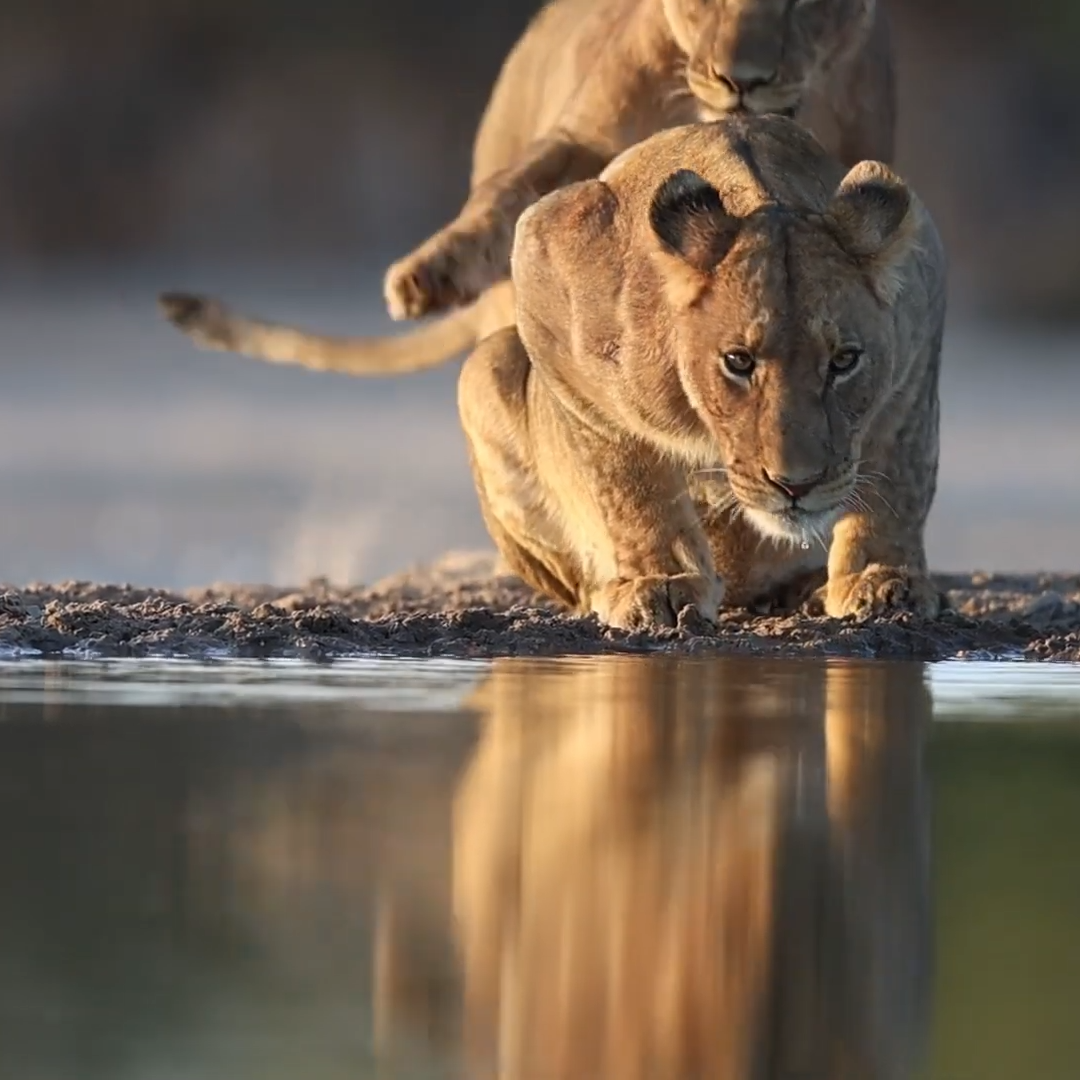
When photographing lions, the golden hours are your best ally. Early morning and late afternoon light paint their fur in warm tones, setting dramatic contrast against the golden grass. Keep your shutter speed high, around 1/1000s or faster, to freeze movement and interaction. Focus on emotion, not just form: the tenderness between a lioness and her cub or the silent tension before a hunt can tell a more powerful story than any portrait.
Elephants, the Delta’s quiet giants, often emerge from the reeds without a sound. Wide-angle lenses capture their scale within the landscape; a telephoto reveals the intimate details, the wrinkles, the tusks, the way sunlight grazes their backs at sunrise. Always maintain distance and respect; the best images come when the animals forget you’re there.
To photograph wildlife in the Okavango Delta is to learn humility. You wait, you watch, and you adapt. Nature moves on her own schedule, and the best photographers are those who learn to blend into her rhythm. A Kgalagadi to Okavango Delta photography safari teaches you exactly that balance, between anticipation and surrender, between art and patience.
Seasons and Secrets: When to Go for the Best Light & Wildlife
The Okavango Delta changes its mood with the seasons, and understanding this rhythm is essential for both travelers and photographers.
From May to August, the dry winter season transforms the Delta into a photographer’s paradise. Though Botswana’s skies remain cloudless, rains from Angola arrive through distant rivers, flooding the plains with life. The result is surreal, water glimmering under crisp air, wildlife concentrated around channels, and visibility so clear it feels otherworldly. Mornings are cool, the air is sharp, and the soft light lingers longer, gifting photographers extra minutes in that perfect golden hour.
From November to March, the wet season sweeps in with dramatic thunderstorms. The landscape greens, migratory birds return, and skies explode with contrast and color. Roads can be muddy, and travel more challenging, but for photographers who brave it, the payoff is spectacular: reflections after rain, saturated hues, and moody, cinematic lighting.
For most travelers on a Kgalagadi to Okavango Delta photography safari, June to October offers the ideal balance, comfortable temperatures, accessible routes, and dense wildlife congregations near shrinking water sources. This is prime time for predator-prey interactions, elephants crossing flooded channels, and sunsets that ignite the Delta in orange and crimson.
Every season has its secrets. The key is to match your creative goals with nature’s cycles. Mtembezi Safaris designs itineraries around these transitions, ensuring you’re always in the right place at the right moment to capture the images you dream of.
Reflections from the Road: Lessons from Africa’s Wild Heart
Traveling from the Kgalagadi’s red dunes to the Okavango’s mirrored lagoons is more than a route; it’s a transformation. Along the way, dust gives way to water, silence to sound, and solitude to abundance. Each photograph becomes a memory etched with awe.
A Kgalagadi to Okavango Delta photography safari is not just about reaching a destination; it’s about discovering rhythm, humility, and purpose through your lens. Africa teaches patience and presence. It shows that photography is not just about what you see, but what you feel while waiting for the light to fall just right. The lions at dawn, elephants in twilight, the honey badger in the shadows, all remind us that the greatest images are captured not in haste, but in harmony with nature’s pace.
For many travelers, this journey marks the beginning of a lifelong passion. The skills you learn here, reading light, anticipating behavior, respecting wildlife, become tools for every adventure that follows. Whether your next stop is Chobe National Park, Moremi Game Reserve, or another wild corner of Botswana, the lesson remains the same: slow down, observe, and connect deeply.
At Mtembezi Safaris, we believe every photographer deserves to experience Africa this way, guided by local expertise, immersed in authentic landscapes, and inspired by the untamed pulse of the wild. Your next great photograph might already be waiting in the golden light of the Okavango Delta. Contact our Expert for planning