
The Ultimate 3 Week Botswana Self-Drive Itinerary (Expert Guide by Mtembezi African Safaris)
There are places in Africa that stay with you long after you leave. Botswana is one of them. This vast, untouched wilderness invites travelers to slow down, explore on their own terms, and feel the thrill of driving into landscapes that still belong entirely to nature.
At Mtembezi African Safaris, we’ve guided countless travelers through Botswana’s wild heart, and one thing remains true: few journeys compare to a well-planned 3-week Botswana self-drive itinerary. It gives you enough time to move at a relaxed pace, pause for wildlife, follow the sandy tracks, sit with a sunset, and truly understand why Botswana is considered one of Africa’s last true frontiers.
Self-driving in Botswana is magical because it offers:
- Freedom: no rigid timetables, no crowded viewpoints
- Authenticity: real wilderness, raw landscapes, no fences
- Adventure: deep sand tracks, riverfront game drives, salt pan crossings
- Privacy: especially in places like Khwai, CKGR, and Mabuasehube
This guide brings together everything travelers consistently say they wish they knew before their trip, the best route, realistic driving expectations, campsite insights, road conditions, and the most rewarding places to visit. Whether you only have two weeks or are lucky enough to spend the full three, this itinerary blends the iconic highlights with the hidden, soul-stirring corners that make Botswana unforgettable.
Mtembezi Safaris, being an East & Southern Africa–based safari operator, has years of on-ground experience planning self-drive, guided, and tailor-made overland journeys. Our team works directly in Botswana, drives these routes often, and supports travelers from planning to real-time assistance on the road.
Every recommendation in this itinerary reflects:
- First-hand route knowledge
- Realistic drive times
- Road condition updates
- Practical safety insight
- Campsite experience and community engagement
This isn’t a generic list of stops; it’s a curated, field-tested 3-week Botswana self-drive itinerary designed for travelers who want adventure without losing the support, structure, and expertise of a trusted safari partner.
The Core 2-Week Route
The foundation of this 3-week Botswana self-drive itinerary is a well-balanced 2-week loop that covers the country’s most iconic and rewarding regions without rushing. This section blends wildlife-rich riverfronts, open floodplains, ancient pans, and the gateway to the Okavango Delta.
Expect smooth transitions between landscapes and manageable driving days. The route minimizes backtracking and ensures you access fuel, supplies, and beautiful campsites at the right moments.
- Kasane & Chobe Riverfront: elephants, buffalo, and river game viewing
- Nata Region: birdlife and open pans
- Kubu Island: mystical baobabs and salt pan crossings
- Makgadikgadi National Park: zebra migration (seasonal)
- Nxai Pan: lions, vast plains, and Baines’ Baobabs
- Maun: Delta hub and supply stop
- Khwai Community Concession: top-tier wildlife and night sounds
Mtembezi African Safaris note: This core loop is perfect for first-time visitors or repeat travelers who want a well-rounded introduction to Botswana’s landscapes and wildlife.
3-Week Extension
For travelers with time and a love for remote wilderness, the final week expands your journey into Botswana’s silent, untouched regions. These areas offer solitude, star-filled nights, and profound encounters with nature. They are more remote, but deeply rewarding.
- Central Kalahari Game Reserve (CKGR): endless horizons, lions, and absolute silence
- Mabuasehube (Mabua): raw wilderness, dramatic pans, and adventurous sand tracks
- Optional Namibia or South Africa extensions: through Transfrontier gates
Mtembezi African Safaris note: These routes demand preparation, fuel planning, and confidence with 4×4 driving, but the rewards are unmatched.
Road Conditions & What to Expect
Botswana’s roads reward patience and awareness. You’ll transition between tar, gravel, and deep sand, often in a single day. Wildlife roams freely, making every stretch of the journey both beautiful and unpredictable.
- Soft sandy tracks in Khwai, Moremi, Mabua, and CKGR
- Occasional corrugation and ruts on bush roads
- Potholes and rough tar between Nata and Maun
- Dusty conditions in the dry season, mud in the rains
- Long distances between fuel and supplies
Mtembezi African Safaris travel advice: Treat every road with respect, never rush, and embrace the journey as part of the adventure.
Driving Tips for a Smooth Self-Drive
Mastering the basics of sand driving and situational awareness will make your journey safer and more enjoyable. Botswana rewards prepared and confident drivers.
- Lower tyre pressure to 1.6–1.8 bar in thick sand
- Engage 4×4 before you need it
- Carry extra fuel and water for remote areas
- Download offline navigation (Tracks4Africa recommended)
- Avoid night driving, as wildlife can appear anywhere
- Observe community campsite etiquette
Mtembezi African Safaris travel advice: Good preparation turns a challenging drive into a memorable adventure.
Best Time & What to Pack (Brief Overview)
The dry season offers excellent wildlife viewing and easier driving conditions. The green season brings dramatic skies, fewer visitors, and beautiful landscapes, but also mud and occasional track closures.
Packing depends on your comfort level and route, but essentials include recovery gear, warm clothing for winter nights, sun protection, and adequate water storage.
Check out our Mtembezi Safari Self-Drive Advice: Best Time to Visit Botswana for a Self-Drive
What to Pack for a Botswana Self-Drive
Below is the full breakdown of how this 3-week Botswana self-drive itinerary unfolds. This is not a rushed point-to-point list, but a realistic, field-tested guide that mirrors how Mtembezi African Safaris plans and drives these routes in real life.
Kasane to Chobe Riverfront to Nata to Kubu Island
Kasane to Chobe Riverfront
- Distance: 10–25 km inside the park
- Driving Time: Flexible based on sightings
- Tyre Pressure: 2.0 bar (normal), reduce to 1.8 on soft sections
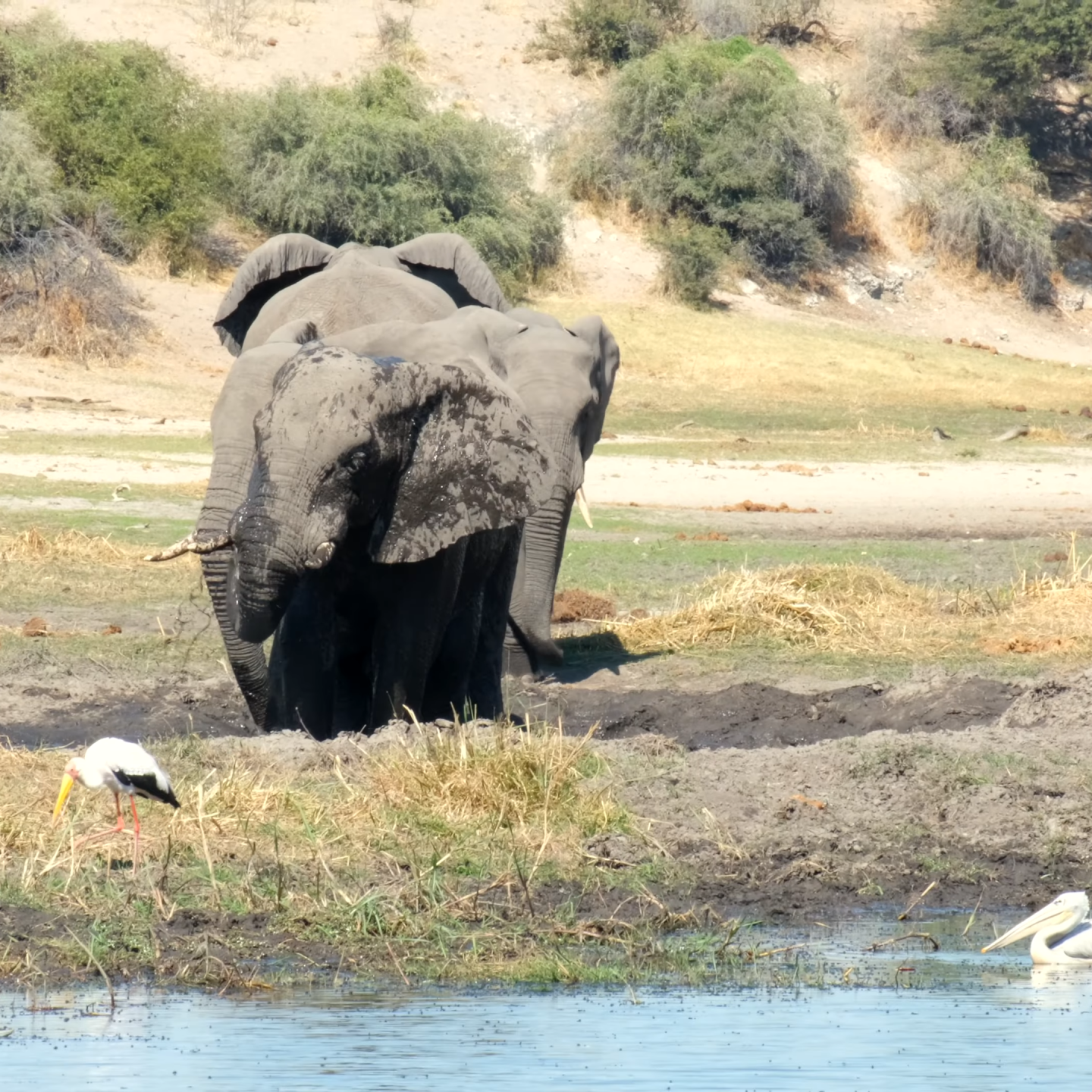
Your adventure starts strong with the Chobe Riverfront, elephants, buffalo herds, predators along the floodplain, and river views that change with every bend. Early drives are irresistible, and you can easily spend a full day exploring the loops near Serondela.
Chobe to Nata
- Distance: ~300 km
- Driving Time: 4–5 hours on tar
The road to Nata is straightforward, but watch for elephants crossing unexpectedly. Fuel, supplies, and restocking opportunities are available in Nata.
Nata to Kubu Island
- Distance: ~100–140 km depending on route
- Driving Time: 3–5 hours (slow, sandy, and rough tracks)
- Tyre Pressure: Drop to 1.6–1.8 bar
Driving onto the salt pans is a spiritual moment; the landscape empties, and Kubu Island rises like a sacred stone ship. Expect bumpy tracks, deep sand pockets, and sudden changes in terrain.
Makgadikgadi to Nxai Pan to Maun to Khwai
Kubu Island to Makgadikgadi National Park
- Distance: 120–150 km
- Driving Time: 3–5 hours
Expect sandy tracks, open horizons, and, depending on the season, migrating zebras and wildebeest moving across the plains.
Makgadikgadi to Nxai Pan
- Distance: 110 km
- Driving Time: 2–3 hours on mixed gravel and sand
Nxai Pan is a complete change of scenery, with grass plains, springbok, towering baobabs, and lions that often use the open areas as hunting grounds.
Nxai Pan to Maun
- Distance: 140 km
- Driving Time: 2 hours
Maun is your reset point: fuel, supplies, tyre checks, and a break from heavy sand driving.
Maun to Khwai Community Concession
- Distance: ~80 km
- Driving Time: 2–3 hours, depending on the sand
The drive gives you your first taste of the Okavango Delta woodlands. Expect elephant crossings, deep sand pockets, and some of the most rewarding wildlife sightings of the trip.
CKGR / Mabuasehube / Transfrontier Extensions
Khwai to Central Kalahari Game Reserve (CKGR)
- Distance: 350–420 km, depending on gate
- Driving Time: 7–9 hours
This is where your 3-week Botswana self-drive itinerary becomes a true wilderness expedition. CKGR is remote, silent, and endlessly vast. Expect deep sand, long distances between camps, and unforgettable sightings of cheetah, oryx, and the famous Kalahari black-maned lions.
CKGR to Mabuasehube (Mabua)
- Distance: 300–450 km, depending on route
- Driving Time: 8–12 hours
Mabua delivers Africa in raw form, no fences, open pans, and lions visiting campsites at night. Driving here requires skill, patience, and excellent vehicle preparation.
Transfrontier Extensions
From Mabua or Tsabong, adventurous travelers can continue into Namibia’s Kgalagadi section or South Africa’s camps.
Expect stricter border checks, fuel planning challenges, and long, dramatic stretches of Kalahari dunes.
Booking Campsites (Honest Guide)
Botswana’s campsites book out months in advance, especially Khwai, Moremi, Savuti, and Mabua. Expect occasional double-bookings; this is normal in the wilderness. Rangers usually resolve calmly by shifting one group to a nearby available site.
Community Campsite Etiquette
- Keep noise low, wildlife is close.
- Support local staff; the fees help village conservation projects.
- Never feed animals.
- Avoid blocking access to water points or riverbanks.
Tyre Pressure & Sand Driving
Most first-time travelers overinflate tyres. In Botswana’s sand:
- 1.6–1.8 bar for soft sand
- 2.0–2.2 bar for gravel
- Lower tyre pressure BEFORE entering deep sand, not after you get stuck
Fuel Management
Distances are long and fuel stations are sparse. Always calculate needed fuel + 30% extra. Carry jerrycans and refill whenever possible, not when you think you “still have enough.”
Safety Tips for Wildlife & Remote Areas
- Never drive after dark.
- Keep 30–50 m from elephants.
- Store food inside the vehicle at night.
- Check your surroundings before stepping out.
- Download offline maps (Tracks4Africa recommended).
- In Mabua and CKGR, assume lions may visit the camp.
Escaping Civilization | Central Kalahari Game Reserve | Episode 1!
BOTSWANA – Selfdrive Makgadikgadi & Nxai Pan safari – Overlanding Africa – Botswana EP2
Best Time to Visit for a Botswana Self-Drive
Botswana changes mood with the seasons. If you want the classic dry-season wildlife concentrations and easier tracks, plan between May and October. If you prefer dramatic skies, fewer crowds, and the green-season drama (with some muddy tracks and the chance to see newborns), consider November to April. We’ll publish a full Mtembezi guide soon with month-by-month recommendations, rain risk, and road-closure notes.Best-time-botswana-self-drive
What to Pack for a Botswana Self-Drive
Packing for a 3-week Botswana self-drive itinerary is about balance: recovery kit and spares for reliability, warm layers for cold desert nights, and sun protection for long days. Essentials include recovery points, a good shovel, compression straps, a quality first-aid kit, plenty of water capacity, and layered clothing. Our dedicated packing page will list Mtembezi-tested kit, vehicle spares checklist, and luggage tips for rooftop tents vs. ground tents.What-to-pack-botswana-self-drive
How difficult is this self-drive route?
The route ranges from easy tar roads to deep sand tracks in Khwai, Moremi, Savuti, and CKGR.
With the right tyre pressures and a bit of patience, most travelers find it very manageable.
Drive slowly, avoid rushing, and follow local advice at each gate.
Is 2 weeks enough?
Yes, but only if you focus on the northern circuit: Chobe, Savuti, Moremi, Khwai, and Maun.
You’ll experience incredible wildlife, but driving days will be tighter and less flexible.
Is 3 weeks better?
Three weeks is ideal. It allows you to combine Chobe, Moremi, Khwai, the salt pans, Nxai Pan, the Delta woodlands, and even CKGR or Mabuasehube without rushing. You’ll have more time for rest days, spontaneous sightings, and real exploration.
Do you need prior 4×4 experience?
Not necessarily. Many first-time 4×4 travelers successfully drive this route. Botswana rewards slow, steady driving, not technical aggression. With proper briefing, tyre pressure management, and common sense, you will be fine.
How safe is it?
Very safe when you stick to daylight driving, respect wildlife distances, and camp responsibly. The main risks are animals at night, dehydration, and getting stuck in sand, all manageable with preparation.
What are the best months for a Botswana self-drive?
June to October is the golden window, dry tracks, clear wildlife concentration, and perfect temperatures. December to April is the green season: lush, beautiful, but with muddy or inaccessible routes in some areas.
How do you combine this itinerary with Namibia?
Most travelers connect via Ngoma Bridge into Namibia’s Zambezi Region, then continue west toward Etosha, Damaraland, or Sossusvlei. Vehicle paperwork, COMESA insurance, and border fees apply, all easy to arrange ahead.
Can you self-drive in Botswana?
Yes, self-driving in Botswana is legal and widely practiced, but it is not comparable to self-driving in destinations like South Africa or Namibia. From first-hand planning and field experience, a Botswana self-drive requires a proper 4×4 vehicle with low range, prior booking of national park campsites, and confidence in remote driving, including sand, corrugation, and water crossings.
Self-drive works best for comfortable travelers who are self-reliant, understand that breakdown support can take hours or even a full day, and prefer immersion over convenience. This is why many travelers choose a hybrid approach, combining self-drive between regions with lodge stays in key areas.
Can you self-drive the Okavango Delta?
You cannot self-drive into the deep Okavango Delta waterways, but you can self-drive within Moremi Game Reserve, which forms the eastern edge of the Delta. Moremi includes unbridged water crossings, especially between June and October, and water levels vary year to year rather than strictly by season.
Self-drive access is limited to Moremi South Gate, the Third Bridge area, and Xakanaxa. For deeper Delta experiences, travelers must fly in by light aircraft or use mokoro and motorboat transfers. This distinction is important for safety, insurance, and route planning.
Is it safe to drive around Botswana?
From an on-the-ground perspective, Botswana is one of the safest countries in Africa. Self-drive safety depends more on environmental risks than crime. Wildlife moves freely across unfenced roads, driving at night is discouraged outside towns, and distances can be long with no fuel, no signal, and no settlements.
Practical safety measures include carrying a satellite phone or Garmin inReach, traveling with two spare tires, maintaining a fuel buffer of 200–300 km, and allowing generous time buffers each day. Botswana is politically and socially stable, but its remoteness must be respected.
How many days should you spend in Botswana on a self-drive safari?
Botswana is not a destination to rush. Seven to nine days suits an entry-level self-drive focusing on Chobe and Savuti or Makgadikgadi. Ten to fourteen days allows a balanced circuit including Chobe, Savuti, Moremi, and Nxai. Eighteen to twenty-one days is ideal for a comprehensive self-drive covering Chobe, Savuti, Moremi, the Central Kalahari, and the salt pans.
Driving days are full days, often six to eight hours, including navigation, sand tracks, and wildlife stops. This is why a three-week itinerary works exceptionally well for Botswana.
What’s the best month to visit Botswana for a self-drive safari?
There is no single best month, only trade-offs. June to October offers excellent wildlife concentration and dry conditions, but deeper sand, challenging water crossings, and higher costs. November to March is the green season with fewer vehicles, lush landscapes, and some muddy or inaccessible routes.
April and May are shoulder months that provide an excellent balance of access, improving wildlife, and better value, and are often ideal for first-time self-drivers.
Why is Botswana so expensive?
Botswana’s cost structure is intentional. Park fees are high to limit visitor numbers, campsites inside reserves are tightly controlled by concessionaires, fuel consumption is higher due to sand driving, and recovery and rescue costs are built into vehicle rentals and insurance.
The result is low-volume, high-value tourism, fewer crowds, and some of Africa’s most pristine wilderness experiences.
Is Botswana safe for US citizens?
Yes. Botswana is consistently ranked among the safest countries in Africa for international travelers. For US citizens, there is no hostility toward foreigners, English is widely spoken, and there is a clear legal framework for tourism with reliable emergency response within towns and parks.
The primary risks are environmental rather than human. With proper planning, Botswana is exceptionally rewarding and secure.
Ready to make this trip real? Whether you want to follow the full 3-week Botswana self-drive itinerary or prefer a shorter 2-week loop, Mtembezi African Safaris can help you plan, equip, and support the journey.
- Planning help: we’ll build a day-by-day plan that matches your vehicle, skill level, and interests.
- Vehicle hire: we can advise trusted local 4×4 rental partners and the right vehicle configuration for sand driving.
- Mtembezi 4×4 assisted self-drive: for peace of mind, we offer guided-assist options: a support vehicle, local driver-guide on-call, and route checks.
Get in touch:
🔗 Book or Enquire
Mtembezi African Safaris: we guide, you discover. Let’s plan your Botswana self-drive adventure.